


Final Girl Game on Kickstarter Closes Era 1 With Its Most Ambitious Series Yet

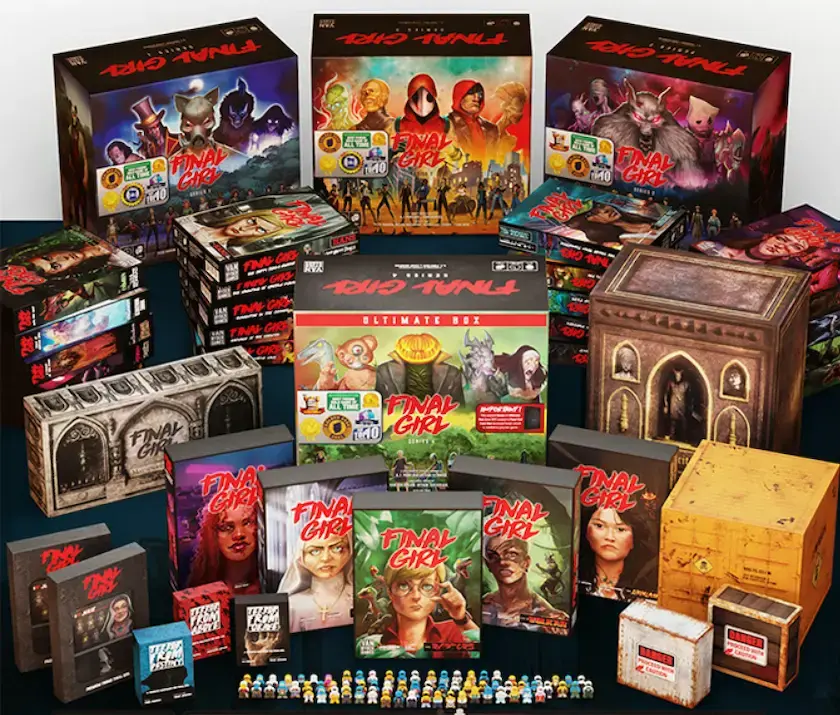
The Final Girl Game on Kickstarter returns with Series 4, expanding one of tabletop's most distinctive solo horror systems. Few solo board games reach this level of longevity — and even fewer manage to expand without losing the tension that made them stand out in the first place. With more than $1.46 million pledged from over 6,400 backers and weeks remaining in the campaign, the project demonstrates the kind of momentum that signals both brand loyalty and genuine appetite for what comes next.
This isn't just another expansion drop.
Series 4 marks the conclusion of "Era 1" for the product line — a transitional moment before the franchise evolves beyond its current series model beginning in 2027. For players drawn to cinematic horror and high-stakes solo gameplay, this release deepens both variety and immersion while closing a chapter that helped define modern solo board gaming.
What Makes Final Girl Game on Kickstarter Stand Out
A Feature Film–Inspired System
At its core, Final Girl is a solo board game that places players in the role of a survivor confronting a relentless killer. Victory demands careful movement, resource management, and tactical decision-making as the night unfolds and the body count rises.
The game revolves around a distinctive Feature Film system, where the Core Box combines with individual Feature Film boxes — each introducing a unique killer and location. This modular design allows players to mix and match elements, creating different gameplay combinations rather than repeating identical scenarios.
It's a structure that treats horror like a genre to explore, not a script to memorize.
Built for Long-Term Replayability
According to the campaign, an all-in configuration can generate 572 unique killer and location combinations. For a solo game, that level of variability is particularly notable — offering long-term table presence rather than a limited narrative arc that exhausts itself after a handful of sessions.
The design encourages players to return repeatedly, exploring different thematic combinations without ever quite exhausting the gameplay possibilities.
Gameplay That Balances Strategy and Survival
Final Girl leans heavily into tension-driven decision making. Players spend time performing actions such as moving, searching for items, resting, or attacking — all while the killer escalates with every victim lost.
The result is a rhythm that mirrors horror pacing: stretches of preparation punctuated by sudden, high-stakes danger.
Action Economy Defines Every Turn
Every decision consumes time. Every moment spent searching is a moment the killer moves closer.
Do you rescue victims to unlock your special ability, or focus entirely on confronting the threat before it's too late?
The design encourages calculated risk rather than reactive play, creating moments where hesitation carries genuine consequences — and where survival often comes down to reading the board one turn ahead.
The Terror Deck Drives Unpredictability
A Terror deck blends cards from both the killer and the location, ensuring each session unfolds differently. As victims fall, the killer grows stronger — reinforcing the sense that time is not on your side.
The pressure tightens.
Ultimately, the game resolves in stark terms: eliminate the killer or be eliminated. Few mechanics communicate genre so directly.
Series 4 Feature Films Expand the Horror Palette
One of the defining strengths of Final Girl has always been its thematic range, and Series 4 continues that approach with five new scenarios that pull from different corners of horror cinema.
The Raptor Games
Set on Isla Lagarto, contestants face coordinated prehistoric predators whose speed and pack behavior make them formidable opponents. The scenario leans into survival horror with enemies that hunt intelligently rather than predictably — circling, testing, waiting for openings.
The Green Terror
Players enter a dense jungle stalked by the Volk'ar — a calculating hunter who studies prey before striking. This feature film emphasizes patience and observation, rewarding players who adapt to being hunted rather than charging forward blindly.
A Demon in the Shadows
A possession narrative unfolds within a troubled abbey, challenging players to confront both supernatural danger and moral stakes. The scenario introduces elements that go beyond physical survival into psychological territory — where the threat isn't just what you can see.
A Rotten Harvest
Madness spreads across rural farmland influenced by an ancient deity awakened through sacrifice. This feature film explores cosmic horror themes where the threat isn't just physical but existential — reality itself beginning to fray at the edges.
Bad Times at Buddyland
An abandoned arcade becomes the stage for animatronic threats powered by unpredictable setup conditions. The scenario captures the unsettling aesthetic of entertainment spaces gone wrong — mascots with broken grins, lights flickering in empty corridors.
Together, these scenarios reinforce the franchise's cinematic identity. Each one functions almost like a playable horror film with distinct atmosphere and pacing.
The End of Era 1 and What Comes Next
Beyond gameplay additions, Series 4 carries structural significance for the franchise.
The publisher confirms this campaign will mark the end of Era 1, with future content shifting away from the traditional series model. Era 2 is expected to allow more flexible releases, ranging from Feature Films to character packs and entirely new formats.
This isn't a reboot. It's evolution.
Importantly, upcoming content will remain fully compatible with existing material, meaning current collections retain long-term value. Some Era 1 items are also unlikely to be reprinted — a detail that may resonate with completion-focused players who view the current campaign as a final opportunity to secure certain content.
This transition signals confidence in the system's foundation while acknowledging room for evolution in how content is packaged and released.
Campaign Performance and Production Approach
The numbers tell a clear story: $1.46 million pledged against a $100,000 goal from 6,401 backers. That's a funding ratio that reflects both brand recognition and audience loyalty built across previous campaigns.
It's the kind of performance that suggests the franchise has moved beyond "promising newcomer" into established territory.
Retail rollout begins June 2025, extending into 2026 depending on the feature film. Shipping will be charged after the campaign through a pledge manager, with costs varying by region — a standard approach for projects of this scale.
Van Ryder Games emphasizes a track record of successfully funded and fulfilled projects while noting ongoing learning with each release. The publisher identifies typical manufacturing and logistics risks but states that quality will not be sacrificed for speed.
Communication, structured stretch goals, and responsiveness to feedback are highlighted as core project principles. For returning backers familiar with the publisher's previous campaigns, that operational transparency carries weight.
Why Final Girl Series 4 Matters in the Current Tabletop Landscape
Among current tabletop crowdfunding campaigns, Final Girl Series 4 stands out less for novelty than for refinement.
The system is already proven. What this campaign offers is expansion — more scenarios, more combinations, and a milestone moment before the franchise transitions into its next phase.
For solo players especially, the design continues to occupy a distinctive niche where thematic immersion and tactical play intersect. In a crowdfunding environment increasingly dominated by massive miniature-heavy projects, Final Girl maintains focus on mechanics and narrative tension rather than component spectacle.
That choice matters.
And as crowdfunding increasingly favors recognizable systems with dependable creators, projects like this often signal stability rather than experimentation. It's a balance that matters to backers weighing risk against reward — especially those who've been burned by ambitious failures.
The campaign also reflects broader trends in solo gaming, where demand for deep, replayable systems continues to grow. Final Girl's success suggests audiences value modularity and thematic variety over linear campaign experiences — a design philosophy that allows players to curate their own horror anthology rather than following a predetermined narrative arc.
A Franchise Entering Its Next Chapter
Final Girl Series 4 does not attempt to reinvent the franchise. Instead, it reinforces the qualities that helped establish its reputation: modular design, strong thematic framing, and tension-driven gameplay that respects both the horror genre and solo board gaming as a craft.
As the closing chapter of Era 1, the campaign carries both forward momentum and a sense of transition. It offers existing fans a comprehensive expansion while positioning the game for whatever direction comes next under the Era 2 model.
For players who appreciate horror themes delivered through tight mechanical design, this represents both an arrival point and a launching pad.
The system has proven itself over multiple successful campaigns. Now it prepares to evolve.
For observers tracking notable tabletop launches, Final Girl Series 4 is clearly one of the campaigns currently shaping the conversation around solo gaming, thematic design, and how established franchises navigate growth without losing their identity.
For more tabletop and gaming campaigns worth backing, check out our monthly selection of top crowdfunding picks across all categories.
FAQ about Final Girl Series 4 on Kickstarter
I’m new to Final Girl — where should I start?
To begin playing Final Girl, you only need the Core Box paired with a Feature Film of your choice. Some scenarios are more beginner-friendly due to lighter rules, including The Happy Trails Horror, Once Upon a Full Moon, Don’t Make a Sound, and Series 4’s Bad Times at Buddyland. New players can start small or jump straight into larger bundles if they plan to build a full collection.
Will the project realistically deliver within six months?
The publisher states that manufacturing files were completed before the campaign launched, with miniature molds already prepared. While timelines in tabletop production always carry some uncertainty, this level of preparation suggests the team is aiming to stay ahead of schedule. Backers can expect updates as production progresses.
Is Final Girl strictly a solo board game?
Final Girl is designed for one player, but many groups choose to play cooperatively by sharing decisions and rolling dice together. This flexible approach has even led the publisher to describe it as a “Solo Plus” experience. Whether played alone or with friends, the tension-driven gameplay remains intact.
Are there Kickstarter-exclusive items in this campaign?
Most content is not exclusive, but the Mystery Boxes are confirmed Kickstarter-only rewards. Some items may also become unavailable as the franchise transitions into its next era, making this campaign a potential final opportunity to secure certain releases. Availability beyond the campaign has not been guaranteed.
What are the miniatures made from, and how large are they?
The miniatures are produced in PVC plastic and follow a roughly 28mm scale, though sizes vary depending on the character. Alternate grey miniatures are available during the campaign, while pre-shaded versions are expected to appear later at retail or through the publisher’s store.
About the Author

Sarah Nowak
Senior Author at GizmoCrowd
Sarah has been covering tabletop games, RPGs, comics, and creative campaigns on Kickstarter, Indiegogo and Gamefound for over 5 years.
Read more...


.png)
