


The TriAxis puzzle on Kickstarter turns balance into a hands-on obsession

Updated: Jun 11
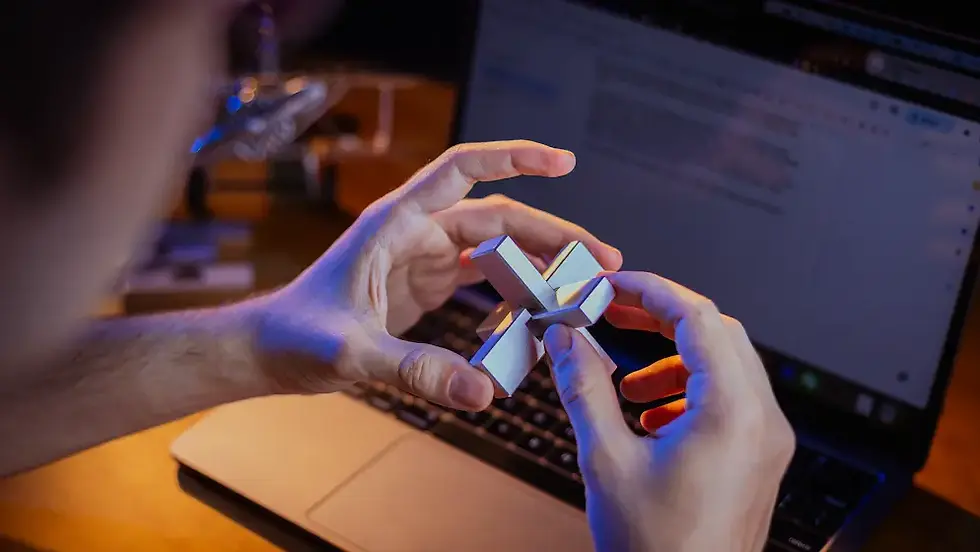
The TriAxis puzzle on Kickstarter has already raised $18,171 from 283 backers, far beyond its initial goal, confirming the appeal of this deceptively simple object. At first glance, TriAxis looks like a clean geometric sculpture. Place it on a desk and most people assume it’s easy. Then they try. Minutes pass. Adjustments become smaller. Focus sharpens. When the final alignment clicks into place, the reaction is immediate. This is not a trick puzzle. It is balance, precision, and patience made physical.
Inspired by aviation and machined to aerospace tolerances, TriAxis positions itself at the intersection of engineering, artistry, and mindful challenge.
Quick Verdict
Who it’s for
TriAxis is made for people who enjoy objects with meaning. Aviation enthusiasts, engineers, designers, puzzle lovers, and anyone who appreciates precision-crafted desk pieces will find it immediately engaging. It works equally well as a hands-on challenge or as a sculptural stand once completed.
Main strengths
A mechanical puzzle rooted in real aviation principles, not abstract difficulty.
Precision-machined aluminum construction with flight-grade finishing.
Dual purpose design, functioning as both a puzzle and a display stand.
A satisfying physical interaction that rewards patience and fine control.
Main limitations
The challenge relies on subtle adjustments rather than fast action.
Its appeal is more contemplative than competitive.
Bottom line: TriAxis is less about solving quickly and more about understanding balance.
When desk objects stop inviting interaction
Many desk objects promise productivity or focus but end up as passive decoration. They look good but offer no engagement. On the other end, digital distractions pull attention away rather than grounding it.
The creators of TriAxis approach the desk differently. They propose a physical ritual that demands presence. Something that slows the moment, requires coordination, and rewards care. The challenge is not artificial difficulty, but the mastery of balance and alignment, concepts borrowed directly from flight.
TriAxis is designed to draw people in, invite curiosity, and turn a quiet moment into a shared experience.
A puzzle built on the three axes of flight
Yaw, pitch, and roll made tangible
In aviation, every aircraft moves around three principal axes: yaw, pitch, and roll. Pilots manage these constantly to maintain stability, direction, and control. TriAxis translates these invisible forces into a physical form.
Each component of the puzzle corresponds to one of these axes. As you manipulate the pieces, you’re not forcing them together. You’re guiding them. Yaw must align. Pitch must settle. Roll must thread into place. Only when all three are coordinated does the puzzle resolve.
The result is a moment of equilibrium that feels earned, not accidental.
A mechanical response that rewards precision
As the pieces approach alignment, resistance shifts. Static friction gives way to smooth movement, followed by a gentle mechanical stop. The geometry self-centers minor misalignment, allowing the final position to feel natural rather than forced.
This interaction is intentional. It mirrors how pilots coordinate controls to stabilize an aircraft. The puzzle doesn’t fight you. It responds to your input.
The TriAxis, Crafted with aerospace-level precision
TriAxis is precision-machined from solid 6061 aluminum, using the same tight tolerances applied to internal aeronautical engine components. Each piece is cut within five thousandths of an inch, then glass-bead blasted and anodized for a flight-grade finish.
This level of machining ensures consistency, smooth interaction, and long-term durability. The mass is balanced for stability. Contact surfaces distribute load evenly. The object feels solid, deliberate, and refined in the hand.
Once completed, TriAxis becomes a stable stand for small keepsakes, turning the solved puzzle into a permanent display piece.
Lineage rooted in aviation history
The story behind TriAxis draws inspiration from early aviation pioneers. In 1914, Lawrence Sperry demonstrated one of the first gyroscopic stabilizers by flying hands-free over the Seine. The idea was simple yet revolutionary: maintain orientation, and the system steadies itself.
TriAxis follows that same philosophy. Geometry replaces electronics. Balance replaces force. Three elements search for alignment, find it, and rest. It’s a quiet homage to the tools that helped pilots find level when the horizon disappeared.
On a desk, TriAxis becomes a small airframe of thought. A reminder that orientation, whether in flight or in focus, comes from coordination.
Manufacturing guided by intent, not shortcuts
The manufacturing process begins in digital space, with detailed 3D modeling and CAM programming. From there, high-speed CNC turning centers with live tooling shape each aluminum billet into its final form.
Surface treatments are chosen to enhance durability and visual clarity, not to hide imperfections. Every step reflects a commitment to precision and longevity. The result is not a novelty object, but a tool-shaped artifact built to remain relevant over time.
TriAxis is launched on Kickstarter as part of Aerohart’s broader mission to translate aviation legacy into modern instruments.
A tactile pause in a busy day
At rest, TriAxis holds objects worth displaying. In motion, it becomes a brief ritual. A few minutes of focus. Small adjustments. A moment of calm when balance returns.
It doesn’t demand constant attention. It waits. And when picked up, it asks only that you slow down and engage.
A puzzle that brings balance back to the desk
The TriAxis puzzle on Kickstarter is not about speed, scores, or spectacle. It’s about understanding alignment, appreciating precision, and enjoying the satisfaction of balance achieved through control.
For those drawn to aviation, craftsmanship, or thoughtful desk objects, TriAxis offers something rare. A puzzle that teaches as it challenges. A sculpture that invites interaction. And a quiet reminder that sometimes, the most rewarding solutions come from small, careful adjustments.
FAQ about The TriAxis on Kickstarter
How much weight can The TriAxis puzzle on Kickstarter hold?
The TriAxis is designed to support significant weight. The creator has personally stepped onto it and allowed it to bear his full body weight without any sign of bending or structural stress.This demonstration highlights the puzzle’s mechanical strength and the robustness of its design, even beyond typical desk use.
What is The TriAxis puzzle on Kickstarter made of?
The TriAxis is made from 6061 aluminum, a material widely used in aeronautical construction. This alloy is known for its balance of strength, light weight, durability, and cost efficiency.
The choice of material reflects the project’s aerospace engineering mindset. It meets strict standards for mechanical resilience, ease of maintenance, and long-term reliability, while remaining suitable for everyday handling.
When will backers receive The TriAxis?
Shipping for The TriAxis is planned to begin in April 2026. Delivery priority will be determined by backer number and the completion of fulfillment information.
If any changes occur in the production or shipping timeline, updates will be shared with backers. At the moment, no delays are anticipated.
Is The TriAxis intended only as a puzzle, or can it be used as a desk object?
The TriAxis is designed to serve a dual purpose. Once solved, it becomes a stable and functional desk stand, capable of holding small everyday objects.
This allows it to transition from an interactive puzzle into a permanent desk piece, blending utility with sculptural design.
Does The TriAxis rely on electronics or moving parts?
No. The TriAxis is entirely mechanical and does not rely on electronics, batteries, or software. Its function is based purely on geometry, balance, and precision machining.
This approach aligns with its aviation-inspired philosophy, focusing on physical principles rather than digital systems.
About the Author

Jonathan
Crowdfunding Strategist & Analyst at GizmoCrowd
Jonathan is Co-Founder of GizmoCrowd and a crowdfunding strategist with over 15 years of hands-on campaign experience on Kickstarter and Indiegogo.
Read more...


.png)
