Is Backing a Kickstarter Project Safe? Understanding the Risks

Updated: Jun 11
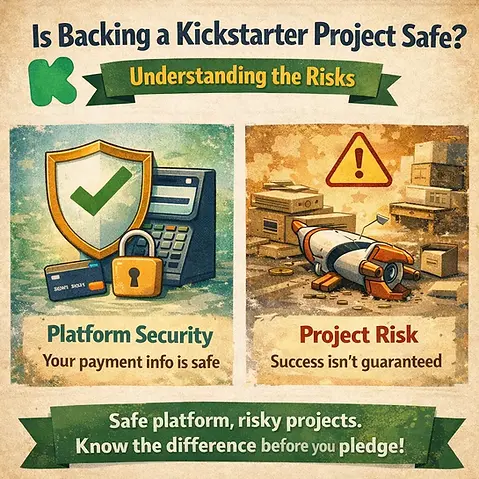
When people ask "Is Kickstarter safe?", they're usually asking two different questions. The first is about platform security—will my payment information be stolen? The second is about project risk—will I actually receive what I'm backing? What happens if the creator stops responding? The answers are very different, and understanding both is essential before you pledge.
Kickstarter is safe as a platform, but projects carry risks
Kickstarter is a well-established platform with secure payment processing and clear rules. From a technical standpoint, backing a project on Kickstarter is safe. Payments are encrypted, and the platform operates transparently.
Your credit card details won't be compromised by using Kickstarter. The platform processes millions of transactions and maintains the same security standards you'd expect from any major e-commerce site.
However, platform safety does not mean that every project is risk-free. Backing a Kickstarter project is fundamentally different from buying a finished product. Backers are supporting a creative effort that may still face challenges after funding.
Understanding this distinction is key to making informed decisions.
The main risks backers should be aware of
Delays in delivery
Delivery delays are one of the most common issues on Kickstarter. Estimated delivery dates are projections, not guarantees. Manufacturing, logistics, and supply chain issues frequently push timelines back, especially for physical products.
Many experienced backers add six months to any estimated delivery date. If a campaign says December delivery, smart backers mentally prepare for June or later.
Manufacturing introduces countless variables. Tooling might need adjustments. Quality control could reveal issues. Component suppliers might face shortages. Shipping logistics can be disrupted by port congestion or customs complications.
Delays alone do not indicate failure. They're part of the Kickstarter ecosystem. Many delayed projects eventually deliver successfully. The real issue isn't the delays themselves—it's how creators communicate about them.
Changes to the final product
Creators may need to adjust materials, features, or design details after the campaign ends. These changes are often made to improve manufacturability or reliability, but they can result in a final product that differs slightly from the original presentation.
A campaign might promise a specific fabric that becomes unavailable. An electronic component might be discontinued, requiring a redesign. Safety testing might reveal that a product needs modifications to meet regulatory standards.
Kickstarter allows such changes as long as creators communicate openly with backers. The platform recognizes that product development is iterative.
Sometimes changes improve the final product. Other times they represent compromises that disappoint backers. The product you receive might not match the campaign video exactly.
Projects that fail to deliver
In some cases, projects fail despite successful funding. This can happen due to underestimated costs, production errors, or unexpected technical challenges. While creators are obligated to explain what happened, delivery is not guaranteed.
A creator might budget incorrectly. Production errors might make items unsellable. Technical challenges might prove insurmountable. Sometimes creators lack the expertise to manage complex production.
In rare cases, creators abandon projects entirely.
This is the fundamental risk: you might lose your money entirely. It's not the most common outcome—the majority of projects do deliver—but it's possible enough that backers should only pledge amounts they can afford to lose.
Backing always involves a level of trust.
What Kickstarter does and does not do for backers
Kickstarter reviews projects to ensure they comply with its guidelines. They check that projects fit within allowed categories and don't violate prohibited content rules. This filters out the most egregious scams.
However, Kickstarter does not verify feasibility, creator experience, or production plans. The platform doesn't assess whether a project is achievable, whether the timeline is realistic, or whether the funding goal is sufficient.
Kickstarter also does not guarantee project success or intervene in fulfillment disputes. If a project fails to deliver, backers can't appeal to Kickstarter for refunds.
Kickstarter's role is to provide a framework for creators and backers to connect, not to act as a marketplace with buyer protection.
How backers can reduce risk before pledging
While you can't eliminate risk entirely, you can make smarter backing decisions. The most reliable signal is how a founder talks about their build process — read our behind the scenes kickstarter campaign series to see what that looks like.
Read the campaign page carefully. Don't just watch the video. Read the entire description. Does the creator demonstrate understanding of production challenges? Do they have a clear plan for manufacturing? Vague answers are red flags.
Review past updates from previous campaigns. If this creator has run successful campaigns before, look at how they communicated. Were they responsive and transparent? Did they deliver on time? A creator's track record is your best predictor.
Check how creators answer questions in the comments. The comment section reveals a lot. Do they respond thoughtfully to tough questions? Do they engage regularly, or disappear for weeks? How they treat skeptical backers during the campaign often predicts how they'll treat frustrated backers during delays.
Look for realistic timelines. A complex hardware project promising delivery in three months is probably unrealistic. Experienced creators build buffer time into their estimates. First-time creators often underestimate significantly.
Assess transparent budgeting. Some campaigns break down exactly how funds will be used— tooling costs, manufacturing, shipping, platform fees. This transparency suggests the creator has done their homework.
Evaluate the prototype stage. Is the creator showing a functional prototype, or just concept renders? Products that already exist in working form are far more likely to reach production successfully.
Consider the creator's expertise. Does the team have relevant experience in manufacturing, product design, or the specific industry? First-time creators with ambitious technical projects face steeper odds.
Projects with clear communication, realistic timelines, and transparent budgeting tend to inspire more confidence for good reason—they're run by creators who know what they're getting into.
The bottom line on Kickstarter safety
Is Kickstarter safe? Yes, as a platform. No, as a guaranteed transaction.
Your payment information is secure. You won't be scammed by Kickstarter itself. The platform operates legitimately and has facilitated billions of dollars in successful funding.
But will every project you back deliver what you expect, when you expect it? No. Some will be late. Some will change. Some will fail entirely. That's the nature of crowdfunding—you're accepting risk in exchange for access to innovative products.
The key is going in with realistic expectations. Understand what Kickstarter is—a funding platform for creative projects—and what it is not—an online store with consumer guarantees.
If you need certainty, wait for products to reach retail. If you're willing to accept uncertainty in exchange for being part of something's creation, Kickstarter can be rewarding despite the risks.
Looking for campaigns that meet strong evaluation criteria? Browse our regularly updated crowdfunding campaigns to watch for projects that stand out for clarity and execution.
For more practical answers to common concerns, backers can consult our regularly updated Kickstarter FAQ, based on real questions asked across live campaigns.
About the Author

Jonathan
Crowdfunding Strategist & Analyst at GizmoCrowd
Jonathan is Co-Founder of GizmoCrowd and a crowdfunding strategist with over 15 years of hands-on campaign experience on Kickstarter and Indiegogo.
Read more...